


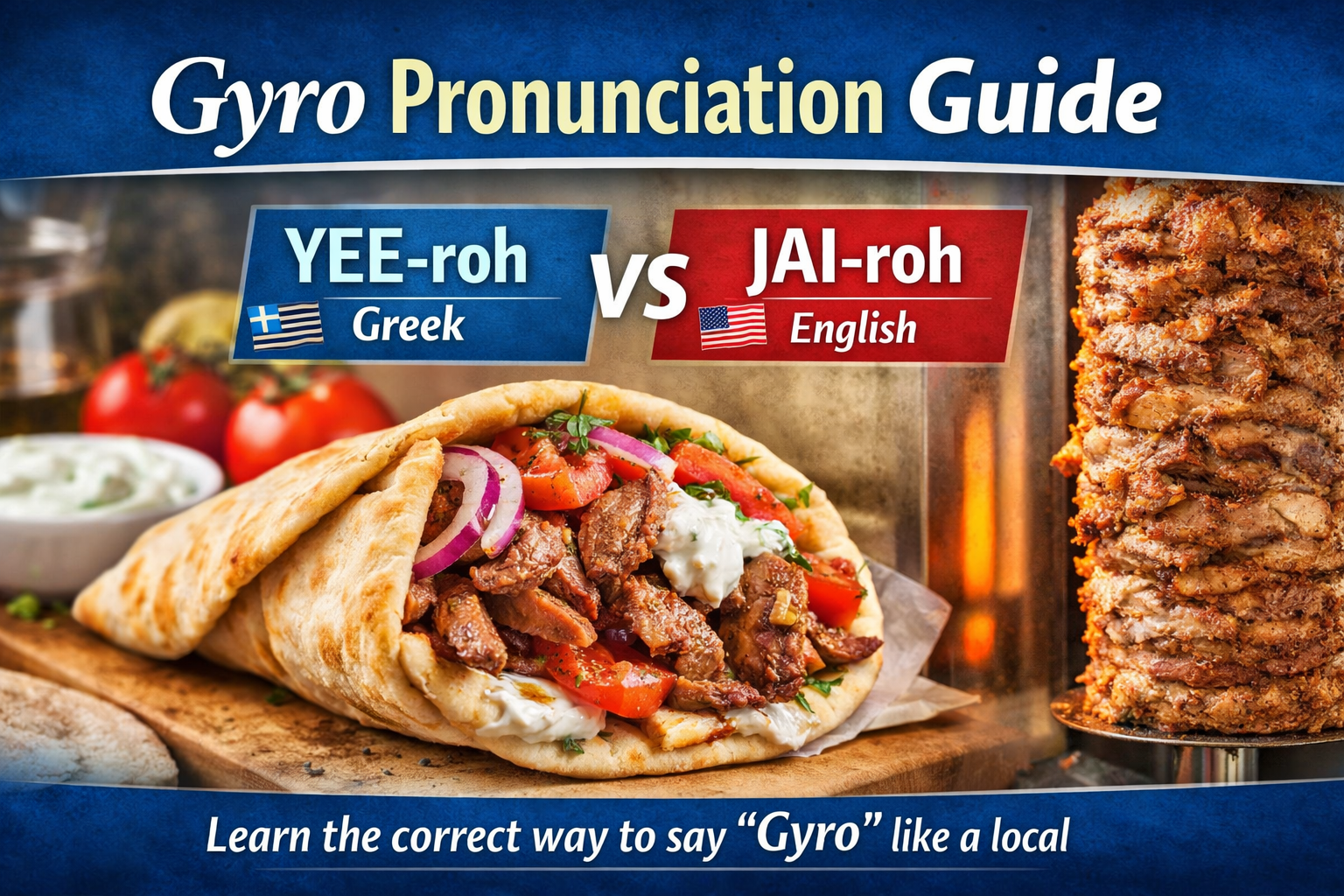
The word “gyro” appears on menus at restaurants, food trucks, and casual dining locations around the world. Despite its popularity as a food item, many people hesitate when it comes to pronouncing the word correctly. Understanding gyro pronunciation is not only useful for ordering food, but it also reflects a deeper recognition of language, culture, and culinary heritage.
This guide explores the pronunciation of “gyro,” the origins of the word, regional differences, common errors, practical tips, and the cultural importance of saying it correctly.
What Is a Gyro?
Before examining pronunciation in depth, it is important to understand what a gyro actually is.
A gyro is a type of sandwich originating in Greece.
It typically consists of:
-
Meat cooked on a vertical rotisserie
-
Thinly sliced or shaved pieces of meat such as lamb, chicken, or pork
-
Served inside a warm, soft pita bread
-
Topped with ingredients such as tomatoes, onions, and tzatziki sauce
The gyro shares similarities with other dishes made with vertical rotisserie meat, including the Turkish döner kebab and the Middle Eastern shawarma. Although these dishes are related, each has distinct origins and names in their local languages.
Because the word “gyro” entered English from Greek, its pronunciation does not follow typical English spelling rules. This difference is a key reason why so many people are unsure of how to say it.
The Linguistic Origin of the Word “Gyro”
The word “gyro” is derived from the modern Greek word γύρος (gyros), which means “turn” or “circle.” This name refers to the circular motion of meat as it rotates on a vertical spit during cooking. The word is directly linked to the way the food is prepared, making the etymology meaningful rather than arbitrary.
In Greek, the letter γ (gamma) has a sound that does not correspond exactly with the English hard “g.” Before certain vowels, γ produces a soft sound that more closely resembles the English “y.” As a result, the word “gyros” in Greek sounds very different from the way most English speakers read the word at first glance.
Understanding the phonetics of Greek helps explain why many English pronunciations diverge from the original Greek pronunciation. Linguists study such differences under the field of phonology, which explores how sounds vary between languages.
Why Gyro Pronunciation Is Confusing
There are several reasons why many people are uncertain about gyro pronunciation, especially in English‑speaking countries.
1. Letters Do Not Map Directly Between Greek and English
The Greek alphabet contains characters and sounds that have no direct English equivalent. The sound represented by the Greek letter γ (gamma) before certain vowels is closer to a soft “y” than to the English hard “g.” However, English speakers often assume that “g” should be pronounced as in words like “game” or “go,” leading to mispronunciations.
2. Familiar English Sound Patterns Influence Pronunciation
When a word from another language enters everyday English speech, speakers tend to adapt it to familiar English patterns. This is known as phonological adaptation. In this case, English speakers apply familiar spelling‑to‑sound rules to the word “gyro,” which leads to pronunciations that differ from the original.
3. Regional Variations in English Pronunciation
English itself is not uniform across all regions. American English, British English, Australian English, and other dialects each have distinct pronunciations for many words, including loanwords from other languages.
These factors combined make “gyro” a word that not all English speakers feel confident saying without hesitation.
How to Pronounce Gyro Correctly
There is no single “correct” way to pronounce “gyro” that applies universally. The pronunciation varies depending on whether the speaker uses Greek or English conventions. Below are the most widely accepted pronunciations.
Greek Pronunciation
In Greek, the word γύρος is pronounced approximately as:
“yee‑roh”
(phonetic: /ˈʝi.ro/)
Key points about this pronunciation:
-
The initial sound is closer to the English “y” than to a hard “g.”
-
The “y” sound appears because the Greek letter γ (gamma) before certain vowels produces a palatal sound similar to “y.”
-
The second syllable is pronounced like the English “roh,” but with a slightly shorter “o” sound than in American English.
This version is considered the authentic Greek pronunciation and is most common among native Greek speakers.
American English Pronunciation
In the United States and in many English‑speaking contexts, “gyro” is commonly pronounced as.
“jai‑roh”
(phonetic: /ˈdʒaɪ.roʊ/)
Characteristics of this pronunciation:
-
The first syllable rhymes with “jive” or “jiffy.”
-
The second syllable is pronounced as “roh,” similar to American English pronunciation of “go.”
-
This pronunciation has become widespread in everyday conversation, menus, and casual speech in the United States.
Although Americans often use “jai‑roh,” this version reflects an English adaptation rather than the original Greek sound.
Other Regional Pronunciations
Although “yee‑roh” and “jai‑roh” are the most commonly recognized pronunciations, regional variations exist.
-
In the United Kingdom and Canada, the American English form “jai‑roh” tends to be the most familiar.
-
Some English speakers attempt hybrid pronunciations that mix elements of each version.
-
In regions with large Greek populations, listeners may be more familiar with the Greek pronunciation “yee‑roh.”
Regardless of regional differences, most listeners are able to understand the intended meaning when the word “gyro” is used.
Common Mispronunciations
Because of its unfamiliar combination of sounds, “gyro” is often mispronounced.
Some of the most common incorrect versions include:
-
“gee‑roh” (rhymes with “hero”)
-
“gi‑roh” (single syllable)
-
“ghee‑roh” (influenced by the Indian word “ghee”)
-
“gu‑roh” (with hard “g” as in “gum”)
These patterns occur because English speakers tend to apply familiar pronunciation rules to foreign words. For instance, “gy” is often read as in “gym” or “gypsy,” which leads to confusion.
From a phonetic standpoint, these mispronunciations do not accurately reflect either the Greek or the English conventions for this word. Recognizing incorrect versions can help learners avoid them in the future.
Practical Tips to Improve Your Pronunciation
If you want to master gyro pronunciation, the following strategies can help.
Break the Word Into Syllables
Understanding that “gyro” consists of two syllables – gy‑ro – makes it easier to practice.
-
First syllable: “gy” or “yee”
-
Second syllable: “roh”
Breaking words into syllables aids clarity and reduces hesitation.
Focus on the Initial Sound
In Greek, the initial sound is closer to “y.” Practicing the correct sound can solidify your overall pronunciation. Try saying “yee” separately several times before combining it with “roh.”
Listen to Native Speakers
Hearing the word spoken by native Greek speakers reinforces correct phonetic patterns. Many language learning websites and pronunciation tools provide audio examples.
Listening actively rather than reading passively engages your speech muscles in new ways.
Use the Word in Everyday Sentences
Practical use helps internalize pronunciation.
For example:
-
“I ordered a gyro for dinner.”
-
“The restaurant serves excellent tzatziki with the gyro.”
-
“He explained the gyro pronunciation to me.”
Repeating the word in context makes it easier to remember.
Practice With Slow, Clear Speech
When learning a new pronunciation, speak slowly and clearly at first. Accuracy is more important than speed. With repetition, your articulation becomes more natural.
Gyro in Everyday Speech
Knowing how to pronounce “gyro” is useful in a variety of situations.
At Restaurants
When ordering:
-
“I would like a gyro with chicken.”
-
“Can you tell me how the gyro is prepared?”
Clear pronunciation enhances communication between you and service staff.
In Conversations About Food
When discussing cuisine with others:
-
“Greek restaurants often serve gyro with tzatziki.”
-
“I learned the authentic gyro pronunciation when I traveled to Athens.”
Using the word confidently can enrich social interactions.
In Writing and Social Media
When writing blog posts, reviews, or social media content:
-
A pronunciation guide in parentheses can clarify your meaning.
-
Including phonetic notation helps readers unfamiliar with the word.
Example: “We tried a Greek gyro (pronounced ‘yee‑roh’).”
Why Pronunciation Matters
Understanding and using correct pronunciation is more than a linguistic exercise. It reflects broader cultural awareness and respect for language diversity.
Promotes Clear Communication
Accurate pronunciation reduces misunderstanding. Whether ordering food or explaining a dish to others, clarity matters.
Demonstrates Cultural Respect
Gyro is a word borrowed from Greek. Pronouncing it as close as possible to the original acknowledges its cultural origin and culinary significance.
Enhances Language Learning
Learning how loanwords function in English reveals patterns in language adaptation. This understanding supports broader language skills.
Conclusion
The question of gyro pronunciation illustrates how language, culture, and cuisine intersect. Although many English speakers use the American adaptation “jai‑roh,” the original Greek pronunciation “yee‑roh” reflects the word’s linguistic roots.
Understanding both versions provides linguistic flexibility and cultural insight. Pronunciation, however, is not merely about correctness. It is also about confidence, communication, and respect for the source language.
Whether you pronounce it “yee‑roh” or “jai‑roh,” your audience will usually understand you. The key is knowing why the differences exist and how each version aligns with regional speech patterns.
By using clear practice strategies and paying attention to phonetics, you can confidently include “gyro” in your vocabulary and spoken speech.
Frequently Asked Questions
1. How do you pronounce gyro correctly like a Greek speaker?
The Greek pronunciation is closest to “yee‑roh.” The initial sound resembles the English “y” rather than a hard “g.”
2. Is the American pronunciation “jai‑roh” wrong?
No. The American pronunciation “jai‑roh” is widely accepted in English‑speaking contexts and understood by listeners, even though it differs from the original Greek.
3. Can both pronunciations be used interchangeably?
Yes. In casual conversation, many people use “jai‑roh.” When speaking with native Greek speakers or in cultural settings, “yee‑roh” may be preferred.
4. Why does the word “gyro” look misleading in English?
The English spelling follows the Greek word’s transliteration, but English phonetic rules do not align with Greek sounds. As a result, English readers often guess the pronunciation incorrectly.
5. Does pronunciation affect the meaning of the word?
No. Regardless of whether you say “yee‑roh” or “jai‑roh,” listeners will understand that you mean the Greek dish composed of vertically roasted meat served in pita bread.


